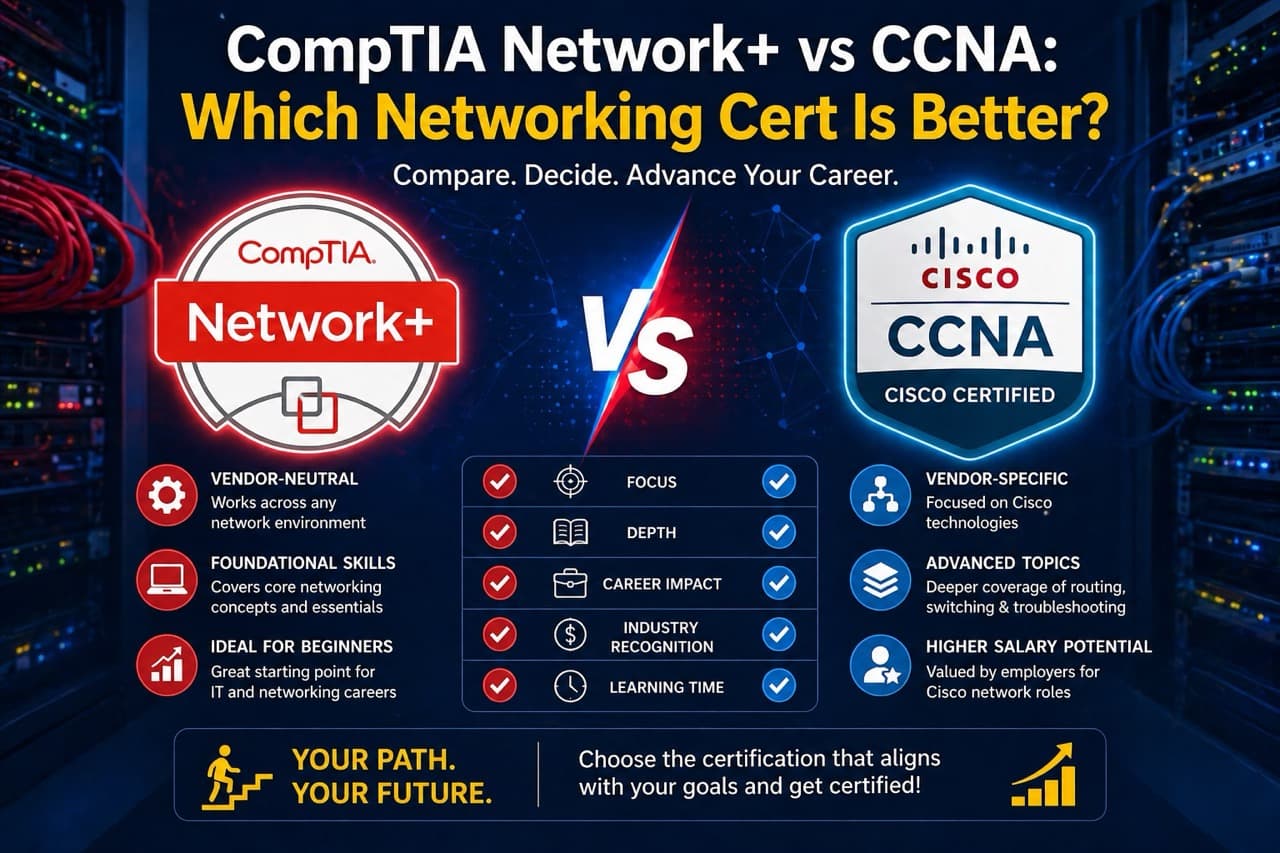
So you're weighing Network+ vs CCNA, and honestly? You're in good company. This is one of the most-debated questions in IT networking, and the answer is rarely as black-and-white as you'd hope. The CompTIA Network+ vs CCNA debate has been going on for years on Reddit, in classrooms, and in IT break rooms across the country. Both certifications cover networking. Both are respected. But they're built for different people, different jobs, and different career paths.
Here's the short version: if you're newer to IT, want a broad foundation, or work in a non-Cisco shop, Network+ is probably the smarter first move. If you're aiming for a dedicated networking career and don't mind a much steeper climb, CCNA opens bigger doors and pays better. The longer version? That's what this guide covers, with a real look at difficulty, cost, salary, job market demand, and how each cert fits into a cybersecurity career.
Quick Comparison Overview
Before we dig in, here's a snapshot of how comptia network+ vs ccna stack up side by side. This is the cliff-notes version. The sections below get into the actual nuance.
Network+ vs CCNA at a Glance
- Vendor: Network+ is vendor-neutral. CCNA is Cisco-specific.
- Exam Code: Network+ N10-009 (current) vs CCNA 200-301
- Cost: Network+ $369 USD vs CCNA $300 USD
- Number of Questions: Network+ up to 90; CCNA around 100-120
- Duration: Network+ 90 minutes; CCNA 120 minutes
- Passing Score: Network+ 720/900; CCNA roughly 825/1000
- Difficulty: Network+ moderate; CCNA notably harder
- Hands-On Component: Network+ minimal; CCNA heavy IOS/CLI work
- Best For: Network+ for entry-level IT and cybersecurity; CCNA for dedicated network engineering
What is CompTIA Network+?
CompTIA Network+ is a vendor-neutral networking certification aimed at IT professionals who need a solid grasp of how networks work, no matter whose hardware is in the rack. The current version, N10-009, covers networking fundamentals, implementations, operations, security, and troubleshooting. It also leans more into modern topics like cloud networking, SDN, and zero-trust principles than previous versions did.
Because Network+ is vendor-agnostic, it doesn't teach you any single company's command-line interface. Instead, you learn the concepts, like the OSI model, subnetting, routing protocols, VLANs, common ports, and wireless standards, that apply across Cisco, Juniper, Aruba, Arista, Meraki, and any other gear you might run into. That breadth makes it especially useful for help desk techs, junior network admins, MSP staff, and anyone moving toward cybersecurity.
CompTIA recommends about 9-12 months of networking experience before sitting for the exam, but plenty of candidates pass it without that. Most people study for 6-12 weeks if they're already in IT. If you're still learning the basics, plan on three or four months minimum.
What is Cisco CCNA?
CCNA, or Cisco Certified Network Associate, is Cisco's associate-level networking certification. The current exam, 200-301, replaced the old multi-track CCNA system in 2020 and now bundles routing, switching, security fundamentals, network automation, programmability, and even basic Python and JSON into a single exam. It's a much wider scope than Network+, and the depth is several levels deeper.
CCNA is built around Cisco IOS, the command-line operating system running on Cisco routers and switches. You won't just answer theoretical questions; you'll be expected to actually configure interfaces, troubleshoot routing protocols like OSPF and EIGRP, build VLANs, set up trunking, and read running configs. The cisco ccna vs comptia network+ split mostly comes down to this: CCNA wants you to do the work, not just describe it.
People who pass CCNA tend to have hands-on lab time, either through real Cisco hardware or simulators like Cisco Packet Tracer or GNS3. And yes, the comptia network+ n10 009 vs ccna comparison consistently shows CCNA demanding more lab hours.
Key Differences: Network+ vs CCNA
The difference between ccna and network+ shows up in a handful of places: vendor focus, depth, hands-on requirements, exam style, and the kinds of jobs each one targets.
Vendor-Neutral vs Cisco-Specific
This is the headline. Network+ teaches you networking concepts you can take to any environment. CCNA teaches you those same concepts plus the specific way Cisco implements them. If you work somewhere that runs Aruba, Juniper, Extreme, Meraki, or even mixed environments (think arista networks vs cisco shops, or aruba networks vs cisco meraki deployments), Network+ knowledge transfers cleanly. CCNA still applies, but you'll find yourself translating from Cisco-speak.
Depth of Content
Network+ goes a mile wide and roughly a foot deep. CCNA goes slightly less wide but several feet deeper. You'll cover subnetting on both, but CCNA expects you to subnet quickly under time pressure and translate between binary and decimal in your head. CCNA dives into routing protocols, spanning tree, port security, and automation in a way Network+ simply doesn't touch.
Exam Format
Network+ has performance-based questions but they're fairly limited and not as punishing as CCNA's simulations. CCNA's sims drop you into what feels like an actual Cisco terminal and ask you to configure things end to end. If you haven't practiced, you'll feel it.
Skill Transfer Reality
CCNA skills mostly transfer to other vendors with some translation. Network+ skills transfer almost universally. If you're unsure where you'll end up working, vendor-neutral knowledge has a longer shelf life.
Is CCNA Harder Than Network+?
Yes, and it's not particularly close. The ccna vs network+ difficulty gap is real, and most people who've taken both agree. On Reddit, the network+ vs ccna difficulty reddit threads consistently rank CCNA as the bigger challenge by a meaningful margin.
What makes CCNA harder? A few things. The breadth is wider. The depth is deeper. The hands-on component is unforgiving. Time pressure during the exam is intense, you can't go back to previous questions, and the simulations eat clock time fast. Add in the new automation and programmability content, and even seasoned network admins find themselves studying topics they haven't touched before.
Network+ is no joke either. It's harder than A+ and roughly on par with Security+ in terms of difficulty, depending on your background. But compared to CCNA? Most candidates describe Network+ as a bridge, and CCNA as the climb on the other side.
How Hard is CCNA vs Network+ for Career Changers?
For career changers without IT experience, the gap feels even wider. Network+ is doable in 3-4 months of dedicated study. CCNA often takes 6-9 months of consistent work, including significant lab time. If you're changing careers and want a faster win, a+ network+ ccna is a common progression that smooths the climb.
Network+ vs CCNA Cost
The comptia network+ vs ccna price difference is smaller than people assume. CCNA actually costs less than Network+ at the exam fee level, $300 vs $369, but the total cost of preparation usually tilts the other way.
- Network+ Exam Fee: $369 USD
- CCNA Exam Fee: $300 USD
- Network+ Total Prep Budget: Usually $200-$600 (study guide, practice tests, optional video course)
- CCNA Total Prep Budget: Usually $500-$1,500 (study materials, practice exams, lab software or hardware, sometimes a boot camp)
- Renewal: Both run about three years and require continuing education or a retake
The ccna vs network+ price comparison also has to account for time. CCNA usually takes longer to prep for, which means more time off from earning, more energy spent, and more burnout risk. Time has a cost too.
Network+ vs CCNA Salary
Money matters. The network+ vs ccna salary gap is real, and CCNA wins on average. That's not because Network+ is weak, it's because CCNA holders typically work in more specialized, higher-paid roles.
Typical Salary Ranges
- Network+ Help Desk / Support Tech: $45,000 - $60,000
- Network+ Network Technician: $55,000 - $75,000
- Network+ Junior Network Administrator: $60,000 - $80,000
- CCNA Network Administrator: $70,000 - $95,000
- CCNA Network Engineer: $80,000 - $110,000
- CCNA + experience (3-5 yrs): $95,000 - $125,000
These ranges shift based on city, industry, and clearance status. Government and defense contractors often pay a premium. Remote networking jobs have flattened some of the geography premium but it's still real.
The network engineer vs ccna question sometimes confuses people. Network engineer is a job title, CCNA is a credential. Many network engineers hold CCNA, but holding CCNA doesn't automatically make you a network engineer. Experience and demonstrated skills still rule.
CCNA or Network+ First?
This might be the single most-asked version of the question: network+ or ccna first? The honest answer for most people is Network+ first, then CCNA if you're sticking with networking. Here's why.
Network+ teaches you the underlying concepts in a vendor-neutral way, which means when you sit down to learn Cisco IOS for CCNA, you're not also fighting to understand subnetting, the OSI model, and routing fundamentals at the same time. You're mapping concepts you already know to a new syntax. That's way easier than learning both at once.
On Reddit, the ccna or network+ first reddit threads echo this. People who tried CCNA first often report wishing they'd done Network+ first to avoid getting lost in fundamentals while also trying to memorize Cisco-specific commands.
When You Can Skip Network+
If you already have networking experience, work in a Cisco shop, or have a clear network engineer trajectory, skipping Network+ is reasonable. The is network+ equivalent to ccna question gets a firm no, but for someone with the right background, the foundation Network+ provides may already be in place. In that case, going straight to CCNA saves time and money.
Network+ or CCNA for Cybersecurity?
The network+ or ccna for cybersecurity question deserves its own section because it comes up constantly. The short answer: Network+ wins for most cybersecurity paths.
Cybersecurity careers, especially SOC analyst and threat intelligence roles, lean heavily on Security+ as the core credential. Network+ pairs naturally with Security+ and gives you the networking knowledge needed to read packet captures, understand firewall rules, and follow attack chains. That's the typical a+ ccna network+ security+ progression people argue about, but for most cybersecurity work, you can drop CCNA from that lineup.
CCNA still adds value if you're heading toward network security engineering, firewall administration (Cisco ASA/Firepower), or roles in shops that run Cisco everything. Otherwise, time spent on CCNA is time you could spend on Security+, CySA+, or hands-on labs in TryHackMe and HackTheBox.
For ccna vs network security as a focus area, recognize that ccna vs network+ for cybersecurity isn't really an either-or; the cybersecurity world cares more about Security+ and analyst-level certs than either networking cert.
Job Market & Employer Demand
Both certifications show up in job postings, but they cluster around different titles. A quick scan of Indeed, LinkedIn, and Dice shows the pattern clearly.
Network+ Job Titles
- Help Desk Technician
- Network Technician
- Junior Network Administrator
- Field Service Technician
- NOC Analyst (Tier 1)
- Cybersecurity Analyst (paired with Security+)
- MSP Support Engineer
CCNA Job Titles
- Network Administrator
- Network Engineer
- Network Operations Engineer
- Cisco Network Specialist
- Voice Engineer (Cisco environments)
- Network Security Engineer (with Cisco gear)
- Pre-Sales Network Engineer
Geography matters too. CCNA carries enormous weight in markets where Cisco dominates, like federal contracting, large enterprise, and telecom. Network+ travels better across small-to-mid-sized businesses, MSPs, and any environment running mixed gear. Conversations like extreme networks vs cisco switches or juniper networks vs cisco systems happen all the time in those multi-vendor shops, and Network+ holders move through them more comfortably.
Keep an Eye on Cloud Networking
The networking world is shifting toward cloud and SDN. Comparisons like azure network engineer associate vs ccna are showing up more often. CCNA still matters, but cloud networking certs (AWS Advanced Networking, Azure Network Engineer Associate) are increasingly important for senior roles. Build the foundation now, then specialize.
Which Is Better for You?
So, network+ or ccna certification, which one wins? It depends on what you're trying to do. Here's a clean way to decide.
Choose Network+ If...
- You're new to networking or IT in general
- You want a vendor-neutral foundation
- You're heading toward cybersecurity
- You work in a non-Cisco or mixed-vendor environment
- You want a faster, less expensive win
- You're building toward general IT roles, not deep network engineering
Choose CCNA If...
- You want a dedicated networking career
- You already have basic networking knowledge
- You work in a Cisco-heavy environment
- You're aiming for network engineer, network administrator, or CCNP later
- You enjoy hands-on CLI work and lab time
- You want higher salary potential right out of the gate
Get Both If...
Plenty of network engineers hold both certs. Network+ first, then CCNA, is a common and well-respected path. If your goal is CCNP eventually, the comptia network+ or ccna reddit consensus is that the two-cert path produces stronger engineers than CCNA alone, even if it takes longer.
Real Talk: The Cost of Time
Here's something people don't talk about enough. Whether you go Network+, CCNA, or both, the real cost is time. Months of evenings and weekends. Burning vacation days for exams. Saying no to social plans because you've got labs to finish. For people already working full-time IT jobs with families, this gets brutal fast.
That's why some IT pros decide to use exam help services for certifications when life gets in the way. Our team at ComptiaHelp has helped hundreds of IT professionals pass CompTIA Network+ when months of solo prep weren't realistic. We focus on CompTIA exams, so we can't help you with CCNA, but if Network+ is your goal and time is the obstacle, we can talk.
Frequently Asked Questions
Frequently Asked Questions
Final Take: Which Networking Cert Is Better?
There's no universal winner in the network+ vs ccna debate. They serve different purposes, different career paths, and different people. The is ccna better than network+ question depends entirely on what you want from your career.
For most people starting out, Network+ is the smarter first step. It's broader, vendor-neutral, easier to pass, and builds a foundation that makes everything that follows easier, including CCNA itself if you decide to pursue it later. For dedicated networking careers in Cisco shops, CCNA is the better long-term investment, just don't skip the foundation work it assumes.
Whichever path you pick, the certification on its own won't land the job. Hands-on practice, real projects, and the ability to explain what you did and why will. Certs open doors. Skills keep them open.
If you're ready to move forward with Network+ and want help navigating the prep, learn how we can support your Network+ certification goals.