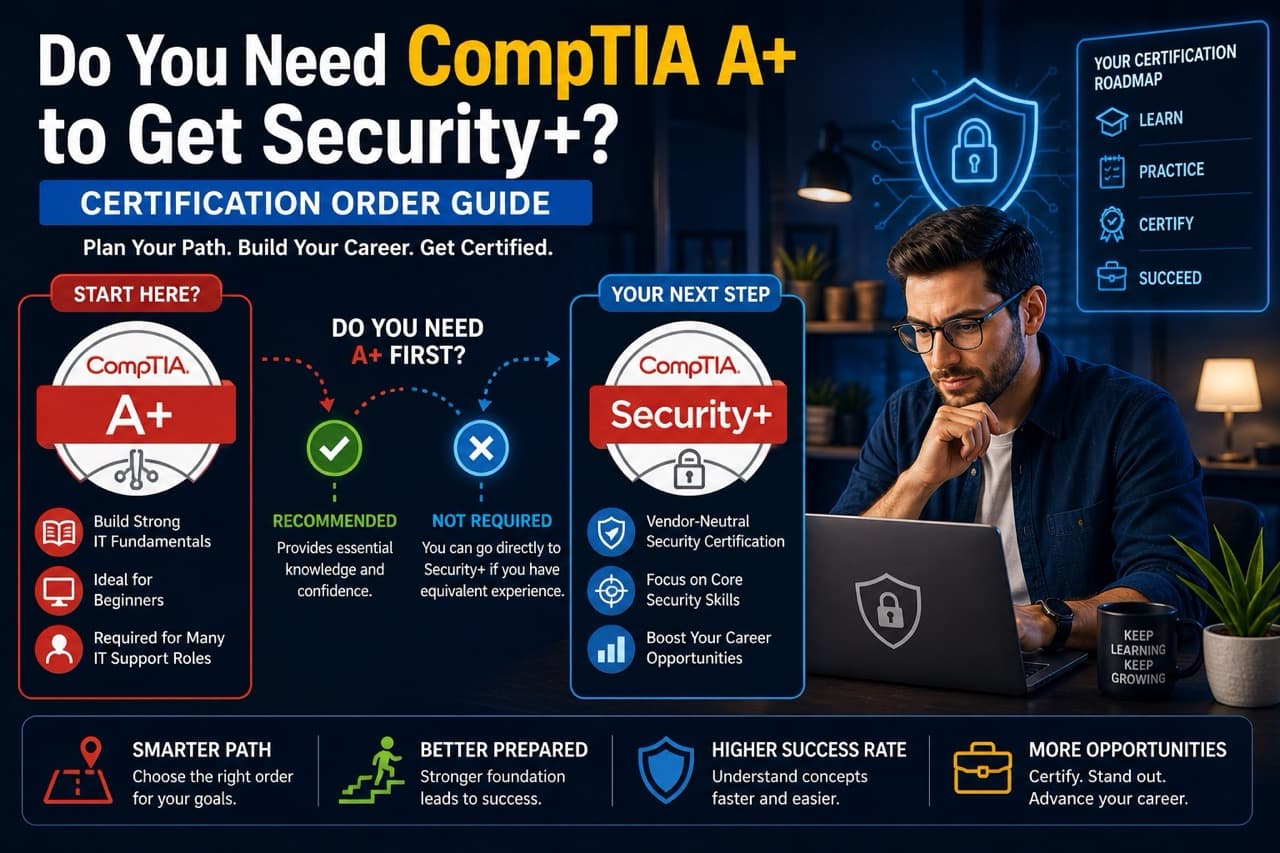
So you're sitting there with a study guide, a tab open to the Pearson VUE registration page, and one annoying question spinning in your head: do you need A+ for Security+? Maybe you've seen forum threads where people swear you must follow the "proper" CompTIA certification order. Maybe a recruiter mentioned A+ in passing. Either way, you want a straight answer before you spend $400 and three months of evenings on the wrong test.
Here's the truth: you do not need CompTIA A+ to take Security+. There's no gate. No locked door. CompTIA itself doesn't require A+ as a prerequisite, and neither does Pearson VUE. But that's only half the story, and the half you actually need depends on your background, your goals, and how comfortable you are jumping into the deep end. Let's unpack all of it.
The Short Answer
No, you don't need A+ for Security+. Period. CompTIA lists A+ as recommended, not required. You can walk into a testing center tomorrow and sit for SY0-701 without ever having heard of the 220-1201 exam. That's the official policy.
But should you skip A+? That's a different question, and the honest answer is "it depends." Some people sail through Security+ without A+ and never look back. Others crash and burn because they didn't realize how much foundational knowledge Security+ assumes you already have. The trick is figuring out which group you're in before you swipe your card.
Quick Facts: Security+ Without A+
- Required prerequisite? No. CompTIA has no mandatory prerequisites for Security+.
- Recommended? CompTIA suggests Network+ and two years of IT admin experience with security focus.
- Will employers care? Most don't. They care about Security+ and your skills.
- Can you skip both A+ and Network+? Technically yes, but networking knowledge is critical.
Official CompTIA Requirements for Security+
Let's look at what CompTIA actually publishes. On their official Security+ page, the "recommended experience" line reads roughly: CompTIA Network+ certification and two years of experience working in IT administration with a security focus. Notice the word recommended. Not required. Not mandatory. Just suggested.
CompTIA does this on purpose. They want their certifications accessible to career changers, students, military folks transitioning out, and anyone else willing to put in the work. If they locked Security+ behind A+ and Network+, they'd cut their candidate pool in half. So the gate stays open. You just have to decide whether you're ready to walk through it.
For comparison, A+ has even looser official requirements. The recommended path is 9-12 months of hands-on experience as an IT support specialist or field service technician. But again, recommended. You can take A+ as a complete beginner if you want. Same goes for Network+ prerequisites, which we cover in detail in another post.
What "Recommended" Actually Means
Recommended doesn't mean "nice to have." It means "the exam is built assuming you already know this." Security+ questions reference subnetting, DNS, DHCP, OSI layers, hardware components, and OS internals without stopping to explain them. If your eyes glaze over when someone says "default gateway," the exam will feel brutal. That's the real meaning of the recommendation.
Why People Ask This Question So Much
The query "do you need a+ for security+" gets searched thousands of times a month. Variations like "security+ without a+," "skip a+ for security+," "do i need comptia a+ before security+," and "do you need a+ to get security+" all come up constantly. Why? A few reasons.
First, money. A+ costs around $370 for two exams (220-1201 and 220-1202). Security+ adds another $404. Stack on study materials, practice tests, and possible retakes, and you're looking at $1,500+ before you even update your resume. People want to know if they can cut that bill in half. Fair question.
Second, time. A+ takes most people 2-3 months of study. If you're trying to break into cybersecurity, three months on hardware troubleshooting feels like a detour. You want to be hunting threats, not labeling motherboard ports.
Third, confusion. The internet is full of conflicting advice. Some YouTubers say "always start with A+." Others scream "skip A+, it's outdated." Forum threads stretch a hundred posts long with no consensus. So people search for clarity, hoping someone will just tell them what to do. (Spoiler: nobody can tell you what to do, but we can give you the framework.)
When You Can Skip A+ for Security+
Skipping A+ makes sense for more people than you might think. Here's when going straight to Security+ without A+ is actually the smart move.
You Have IT Work Experience Already
Worked at a help desk for a year? Built PCs as a hobby for a decade? Set up Wi-Fi networks for friends and family? You probably already know 70% of A+ content. Sitting through study videos that explain RAM types and printer drivers is going to feel like watching paint dry. In that case, A+ mostly validates skills you already have, which is fine if you need it for HR filters but redundant if you don't.
You're a Career Changer From a Technical Field
Engineers, developers, system admins from non-Windows worlds, military signal corps folks, even tech-savvy teachers with home labs. If you understand how computers work, what an IP address is, and why backups matter, you can probably handle Security+ without A+ as a stepping stone. Plenty of career changers do exactly this.
Your Target Job Doesn't Require A+
Pull up ten cybersecurity job postings on Indeed right now. Count how many list A+ as required. The answer will be close to zero. SOC analyst roles want Security+ or higher. GRC positions care about CISSP and CISM. Pen test gigs ask for OSCP and PenTest+. If your career destination doesn't name A+ on the job description, why grind for it?
You're on a Tight Timeline
DoD 8140 deadline at work? Promotion review in six months? Job offer contingent on certification? Time-boxed situations change the math. A+ adds 8-12 weeks to your path. If you don't have those weeks, skipping A+ for Security+ is often the right call, especially if you can get help with the Security+ exam itself to lock things in faster.
Skip A+ If You Check These Boxes
- You have 1+ years of any IT or technical work
- You can confidently explain TCP/IP and DNS basics
- You've built or troubleshot computers before
- Your target job posts don't mention A+
- You have a deadline or financial pressure
When You Should Get A+ First
Now flip it. There are real situations where doing A+ before Security+ is the right move. Don't skip just because skipping sounds faster. Sometimes the longer road is shorter.
You're a Complete IT Beginner
If your tech background is "I use Excel at work and I built a desk once," please start with A+. Security+ assumes you understand how operating systems schedule processes, how networks route traffic, and how authentication actually works under the hood. Without that base, every Security+ chapter will feel like reading a foreign language with a dictionary that's also in a foreign language.
You're Pursuing a Help Desk or IT Support Role
Plenty of entry-level IT support jobs explicitly list A+. Help desk, desktop support, field tech, junior sysadmin. These postings often don't care about Security+ at all. If your near-term goal is getting into IT (any role), A+ is still the gold-standard entry ticket. Check our breakdown of entry-level IT jobs with CompTIA A+ for specifics.
You Want the Long-Term Foundation
Security pros who skip A+ sometimes hit a wall later. They can quote NIST frameworks but can't reimage a laptop. They know what a SIEM is but freeze up when asked to troubleshoot a printer queue. If you want to be the well-rounded IT professional who can do it all, A+ first is a defensible choice. Boring? Maybe. Useful? Absolutely.
You Need Confidence-Building Wins
Some people thrive when they stack small wins. A+ first, then Network+, then Security+. Each pass builds momentum. If you're someone who gives up easily when overwhelmed, this gradual ramp can be the difference between a finished certification path and a half-read PDF gathering digital dust on your hard drive.
The Recommended CompTIA Certification Order
Let's talk about the comptia certification order in general, because Security+ doesn't exist in isolation. CompTIA officially groups its certifications into a rough tiered structure. Understanding that structure helps you decide where to jump in.
The Classic Path
A+ → Network+ → Security+ is the textbook sequence. It's called the CompTIA "trifecta" for a reason. Each cert builds on the last. A+ teaches you hardware, OSes, and basic troubleshooting. Network+ adds networking concepts, protocols, and architecture. Security+ puts a security lens on top of everything. By the end, you have a coherent foundation.
This path is optimal for true beginners and IT students. If you're 18 and just starting out, follow it. You'll thank yourself when Security+ feels manageable instead of terrifying.
The Cybersecurity Fast Track
Network+ → Security+ → CySA+ or PenTest+ skips A+ entirely. Common for people who already have IT experience and want to move into security fast. We covered this in our piece on CompTIA A+ vs Security+. The fast track works if you have the foundation. If you don't, it backfires.
The Direct Security Jump
Just Security+. Some people skip A+ and Network+ both. They go straight to Security+ on the strength of self-study and prior tech experience. It's the riskiest path but also the fastest. Plenty of career changers pull it off, especially with concentrated study and good practice exams.
CompTIA Certification Order Summary
Beginners (no IT experience): A+ → Network+ → Security+
Some IT experience: Network+ → Security+
Strong tech background: Security+ directly
Already in security: Security+ → CySA+ → PenTest+ or CASP+
What About Network+ in the Middle?
Quick detour, because this comes up constantly. People ask "do you need network+ for security+" almost as often as they ask about A+. Same answer: not required, but often more relevant than A+.
Here's why. Security+ leans heavily on networking concepts. Firewalls, VPNs, IDS/IPS, network segmentation, VLANs, ports and protocols, packet captures. If you can't tell a TCP handshake from a UDP datagram, those domains will feel impossible. Network+ specifically prepares you for this.
Many people argue you should skip A+ but keep Network+ when prepping for Security+. This is solid advice if you have to choose one. Hardware troubleshooting helps you on the help desk. Networking knowledge helps you on the Security+ exam and in the actual security job. Read more in our A+ vs Network+ comparison if you're weighing those two.
Career Goal Considerations: What Are You Actually Trying to Do?
Whether you need A+ for Security+ depends massively on where you're heading. Here are the most common scenarios and what we'd recommend for each.
Scenario 1: Breaking Into Cybersecurity
You want to be a SOC analyst, threat hunter, security engineer, GRC analyst, anything with "security" in the title. Skip A+. Go Security+ directly, or do Network+ then Security+. Hiring managers in cyber don't weigh A+ heavily, and you'll have plenty of follow-up certs to stack like CySA+.
Scenario 2: Help Desk to IT Support Role
Your first IT job is the goal, doesn't have to be security. Get A+. It's the de facto entry ticket. Skip Security+ until you have a job and want to advance. Doing them in the wrong order here actually hurts your resume.
Scenario 3: Military or Federal Government Path
DoD 8140 (formerly 8570) requires specific certs for specific roles. Security+ is on the list. A+ usually isn't. If you're trying to land a government cybersecurity position, prioritize Security+. Add CySA+ later. A+ is optional unless your specific role requires it.
Scenario 4: Already Working in IT, Want to Specialize
You're a sysadmin, dev, or network tech who wants to pivot into security. You don't need A+. Skip it. Go straight to Security+. Use your existing experience to fill in any gaps that A+ would have covered.
Scenario 5: Total Career Switcher From Non-Tech
Coming from teaching, hospitality, finance, retail? Mixed answer. If you're patient, A+ first builds a real foundation that pays off for years. If you're ambitious and have time to grind, you can skip to Security+ with disciplined self-study. Either works. The wrong move is jumping into Security+ casually and getting clobbered.
The Real Trade-offs of Skipping A+
Let's be honest about what you give up when you skip A+. There are real costs, and pretending otherwise is the kind of bad advice that floats around YouTube comments.
Trade-off 1: Knowledge Gaps Show Up Eventually
A+ covers stuff you'll bump into for years. Boot sequences, BIOS/UEFI, RAID, mobile device security, basic scripting, group policy, registry navigation. Skip A+ and you might be the security analyst who knows what a SIEM is but can't explain why a Windows machine won't boot. Awkward.
Trade-off 2: Some Employers Use A+ as a Filter
Mostly entry-level IT shops, but it happens. An ATS (applicant tracking system) might filter resumes for A+ keyword matches. Without A+, your resume could get tossed before a human sees it. This is rare in pure security roles but more common in mixed IT/security positions.
Trade-off 3: Confidence on the Security+ Exam
People who do A+ first often report that Security+ felt easier because the foundation was solid. People who skip A+ sometimes hit unexpected walls. If your study time is limited and your background is thin, A+ first might genuinely be the faster path to passing Security+ in fewer attempts.
Trade-off 4: The Sunk Cost Question
If you do A+ then Security+ then realize you don't need A+, you can't un-spend the $370 and the months. On the other hand, if you skip A+ and fail Security+ twice, you might spend more retaking Security+ than you would have spent on A+ in the first place. There's no risk-free option. There's only the option that fits your situation.
How to Decide for Yourself
Alright, enough hedging. Here's a practical decision framework. Answer these honestly and you'll know which path is yours.
The Self-Assessment
Read the following statements. Count how many you can answer "yes" to honestly:
- I can explain what an IP address does in plain English
- I've installed an operating system at least once
- I know the difference between RAM and storage
- I understand what a firewall is and roughly how it works
- I can navigate the command line on at least one OS
- I've troubleshot a tech problem without Googling everything
- I know what TCP/IP, DNS, and DHCP mean (even loosely)
- I've worked in any IT-adjacent role for 6+ months
0-3 yeses: Start with A+. You need the foundation. Skipping straight to Security+ will probably end in frustration and a failed exam.
4-6 yeses: Network+ then Security+ is your best bet. You have enough base to skip A+ but not quite enough to jump to Security+ alone.
7-8 yeses: Go straight to Security+. You have the background. A+ would mostly be busywork at this point, and your time is better spent on Security+ prep.
Don't Forget the Money Math
Failing Security+ once costs $404 plus a 14-day waiting period. Failing twice costs $808 plus extra prep time. If skipping A+ raises your fail risk significantly, you might come out behind even on a "cheaper" path. Pick the path that maximizes your first-time pass odds, not the one that looks cheapest on paper.
The Time and Money Math
A+ costs roughly $740 (two exams). Add $200 for study materials. Total: $940. Time: 8-12 weeks for most people. Security+ costs $404. Add $150 for materials. Total: $554. Time: 6-12 weeks depending on background.
Doing both: ~$1,500 and 4-6 months total. Doing Security+ alone: ~$554 and 2-3 months. The savings are real if you can make the direct jump work. The losses are also real if you can't.
If You're Stuck on Security+ Prep
Some people start studying for Security+ and realize halfway through that they're drowning. Hardware concepts they assumed they'd pick up never click. Networking topics blur together. The exam date approaches and confidence slips. If that's you, you have options.
One option: pause, do A+ or Network+, then return to Security+ with better footing. Another option: get professional help. Our team helps IT professionals every day who've hit that wall. If you need someone qualified to take your CompTIA Security+ exam for you, we've been doing this work since 2014. We also help with CompTIA A+ exam assistance and Network+ exams for people who want to lock in their certifications without risking another fail.
Frequently Asked Questions
Frequently Asked Questions
Final Thoughts: A+ Isn't a Gatekeeper
Coming back to the original question, do you need A+ for Security+? No. Not by CompTIA's rules, not by employer standards, not by any official mandate. Security+ without A+ is completely doable, and thousands of people pass it that way every year.
But the real question isn't whether you need A+. It's whether you would benefit from A+ given your background and goals. For total beginners with zero IT exposure, A+ saves you from a brutal Security+ experience. For experienced techies and career changers from related fields, A+ is a detour you can probably afford to skip.
The comptia certification order matters less than your individual readiness. Listen to advice, but trust your own self-assessment. And whatever path you pick, commit to it. Don't half-study A+ while half-studying Security+. Pick a lane, drive hard, and pass the exam.
Need help getting your Security+ certification across the finish line? Whether you're skipping A+ or stacking certifications, our Security+ exam assistance takes the pressure off. We've helped hundreds of IT professionals secure their certifications without the study-grind nightmare. Your career timeline doesn't have to wait for the "perfect" certification order.