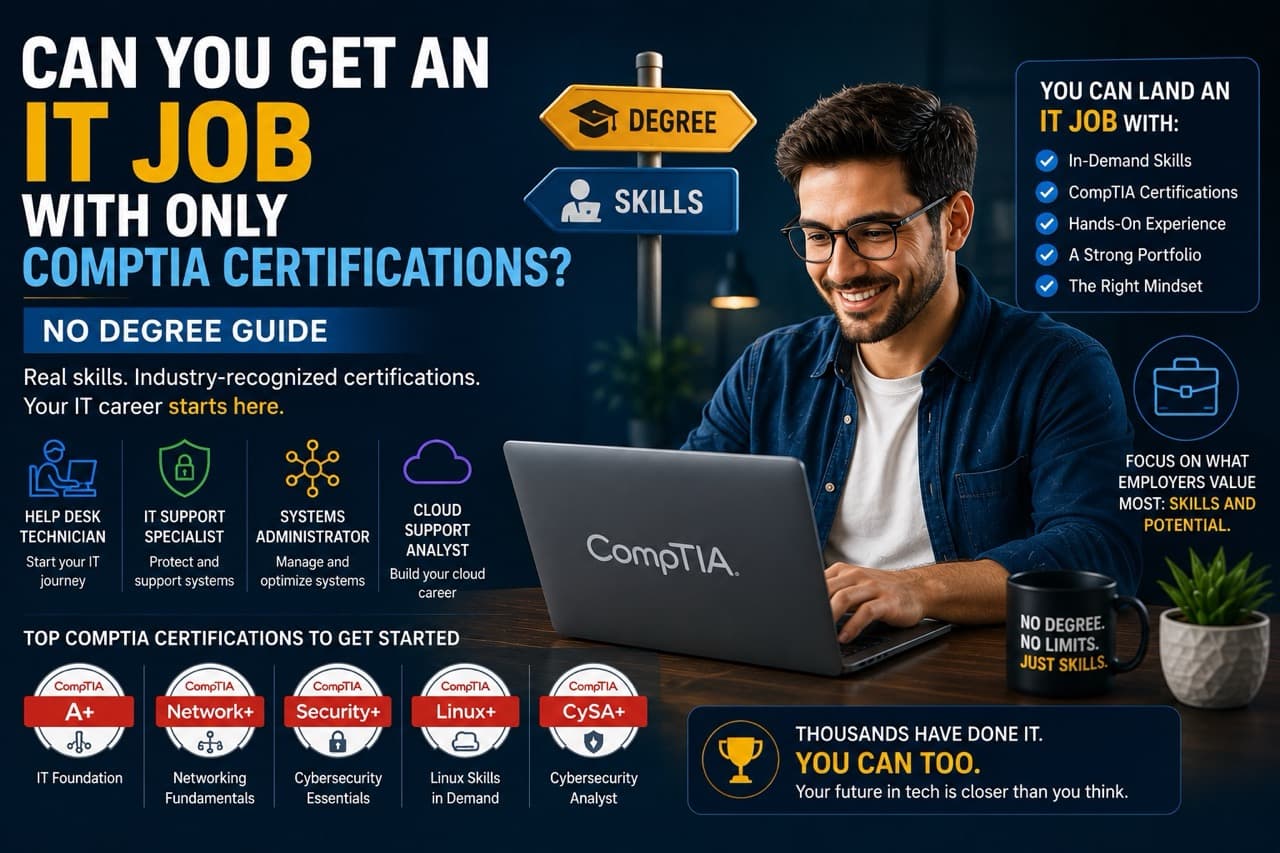
Can you get an IT job with just CompTIA certifications and no college degree? Short version: yes, absolutely. Longer version: it depends on which certifications you have, how you position yourself, and which employers you're targeting.
I know that's not the definitive "yes, just do X" answer most people want. But the truth is that the IT job market without a degree is genuinely navigable if you understand how it works. Thousands of people land IT jobs every year with nothing but CompTIA certifications and some practical know-how. Some of them go on to six-figure careers. The degree thing really is optional in ways that most other fields simply aren't.
This guide walks through exactly how to do it—which certifications matter, what employers are looking for, which entry-level IT jobs are realistic to land, and how to build the experience that makes your resume competitive even without a diploma.
The Short Answer: Yes, It Works (Here's Why)
IT is one of the few industries where demonstrated skills genuinely trump credentials. A developer who can ship working code, a network admin who can troubleshoot a flapping BGP route, a security analyst who can read SIEM alerts—employers care about what you can do, not where you studied.
CompTIA certifications were built for exactly this reason. They exist as an alternative credential system that validates technical knowledge without requiring a four-year degree. When a hiring manager sees CompTIA A+ on a resume, they know what it means: this person understands hardware, software troubleshooting, operating systems, and basic networking. The certification is the signal.
This isn't just theory. The U.S. Department of Defense uses CompTIA certifications as the baseline qualification standard for IT security roles under DoD 8570.01-M. Federal contractors, managed service providers, telecommunications companies, and thousands of small businesses hire based on certs, not diplomas. Getting a job with CompTIA certifications and no degree is a well-worn path.
CompTIA Certification Holders in the Workforce
- Over 2.5 million CompTIA certifications have been issued worldwide
- CompTIA A+ is recognized by major employers including Dell, Intel, and HP
- DoD 8570 mandates specific CompTIA certs for federal cybersecurity roles
- Many MSPs and IT staffing firms prefer certifications over degrees for technical roles
What Employers Actually Want (And How Certs Fit In)
Here's something most "get an IT job without a degree" guides gloss over: employers aren't all the same. A Fortune 500 company's HR department filtering résumés through an ATS that flags for degree requirements is very different from a 50-person MSP where the owner just needs someone who can fix computers without breaking things.
Targeting the right employers matters enormously when you're going the comptia without degree route. Here's who's most cert-friendly:
Managed Service Providers (MSPs)
MSPs are companies that provide outsourced IT support to small and mid-sized businesses. They're often the best first employer for someone with CompTIA certs and no degree. MSPs hire volume—they need technicians who can show up, troubleshoot, and keep clients happy. A+ and Network+ are practically the unofficial job requirements. Experience matters more than education, and they'll give you that experience.
Government and Defense Contractors
This one surprises people. Federal jobs and defense contractor positions often care more about security clearances and specific certifications than degrees. Security+ is DoD 8570 approved for IAT Level II positions. CySA+ covers IAT Level III. CASP+ applies to IAE Level III. None of these require a degree to earn or to use when applying. The government IT career path without college is genuinely real.
Telecom and ISPs
Network+ holders find solid traction at telecommunications companies and internet service providers. Field technicians, NOC analysts, and network support roles at these companies typically prioritize technical certifications over academic credentials.
Small and Medium Businesses
The SMB market is where a huge chunk of IT jobs actually live. Small businesses need IT support, rarely have a large IT department, and often just need someone competent. For these employers, seeing A+ and maybe Security+ on a résumé is plenty. They want to know you can handle the job, not that you sat through four years of college lectures.
Which CompTIA Certifications Matter Most for Getting Hired
Not all CompTIA certifications carry equal weight in the job market. Some open doors immediately; others are better suited for career advancement after you're already employed. Here's how to think about it.
CompTIA A+: The Front Door
If you want an IT job with CompTIA certifications and no degree, A+ is where you start. It's recognized as the baseline qualification for IT support roles across the industry. Employers know what A+ means. Entry-level IT jobs with CompTIA A+ include help desk analyst, desktop support technician, and field service technician.
A+ covers hardware troubleshooting, operating system installation and configuration, mobile devices, networking basics, virtualization, cloud computing fundamentals, and security concepts. Passing both Core 1 (220-1101) and Core 2 (220-1102) earns the certification. The exam cost runs about $253 per exam, so roughly $506 total for both—significantly cheaper than a semester of college.
CompTIA Network+: The Networking Path
Network+ builds on A+ fundamentals and targets networking roles specifically. Network administrators, NOC technicians, and junior network engineers often need this cert. It's also a DoD 8570-approved certification, which opens government contractor opportunities.
The combination of A+ and Network+ is particularly powerful for someone building an it career without college. It signals both general IT competency and networking depth—a combination that covers a wide range of job openings.
CompTIA Security+: The Salary Multiplier
Getting a job with CompTIA Security+ certification meaningfully changes your income trajectory. Security-focused roles pay more than general IT support, and Security+ is the most widely recognized entry-level security certification that exists. It's required for many government and defense contractor positions.
If your goal is eventually earning six figures without a degree, Security+ is almost certainly on the path. It validates that you understand threats, vulnerabilities, cryptography, identity management, and risk management—the stuff that gets organizations breached when someone doesn't know it.
Recommended Cert Stack for No-Degree Job Seekers
- Starting out: CompTIA A+ — opens entry-level IT support roles immediately
- After 6-12 months: Network+ — broadens into networking and raises salary ceiling
- After 1-2 years: Security+ — unlocks cybersecurity roles and government opportunities
- Advanced path: CySA+ or CASP+ — for senior security roles with top-tier salaries
Other Certs Worth Considering
Beyond the core stack, a few other CompTIA certifications are worth knowing about depending on your target role:
- Linux+: Essential for sysadmin and DevOps-adjacent roles. Linux administrators earn strong salaries and the cert is valued by cloud-focused employers.
- Cloud+: Valuable as cloud infrastructure becomes the default. Pairs well with AWS or Azure associate certifications from other vendors.
- PenTest+: For those interested in ethical hacking and offensive security roles. More niche but growing in demand.
One cert that's often overrated for job-seekers: ITF+ (IT Fundamentals). It's designed for people with no IT background who want to test the waters—not for active job hunting. If you're serious about getting hired, skip it and go straight to A+.
Entry-Level IT Jobs You Can Realistically Land
Let's get specific about what comptia jobs with no experience actually look like. These are real positions that actively hire CompTIA-certified candidates without requiring degrees.
Help Desk Analyst / IT Support Technician
This is the most common entry point. Help desk roles exist everywhere—corporate IT departments, MSPs, call centers, healthcare systems, universities. They handle password resets, hardware troubleshooting, software installs, and user education. A+ is typically the only certification needed. Salaries start around $35,000-$50,000 depending on location, with MSPs often paying slightly less but providing broader experience faster.
Help desk is unglamorous. The work can be repetitive. But it builds experience, gets you into corporate IT environments, and gives you the foundation to move into more specialized roles within 1-2 years. Don't skip it because it sounds boring.
Desktop Support Technician
Similar to help desk but with more hands-on hardware work. Desktop support techs configure workstations, deploy equipment, troubleshoot hardware failures, and maintain inventory. A+ is the standard qualification. Salaries range from $40,000-$60,000 for entry-level positions.
Field Service Technician
Field techs travel to client sites to install and repair equipment. This is a good option for people who don't want to sit at a desk all day. A+ is typically required; telecom companies also like Network+. Pay varies widely based on company and location, but $45,000-$70,000 is common for experienced field techs.
NOC Technician (Network Operations Center)
NOC technicians monitor network infrastructure and respond to alerts. It's a 24/7 environment with shift work, which deters some candidates—meaning less competition for entry-level openings. Network+ is the standard credential. Starting salaries hover around $45,000-$65,000, with rapid advancement possible for those who develop deeper networking skills.
Junior System Administrator
Junior sysadmin roles are a step up from help desk and desktop support. They involve managing servers, user accounts, backups, and infrastructure. Employers usually want A+ plus Network+ or Linux+ for these positions, along with some demonstrated hands-on experience. Salaries start around $50,000-$70,000.
IT Support Specialist at Small Businesses
Many small and medium businesses hire a single IT person to handle everything. These "IT generalist" or "IT support specialist" roles often just need A+ and someone reliable. The pay is variable but the experience is unbeatable—you'll touch every aspect of IT operations.
Entry-Level IT Salary Ranges (2026)
- Help Desk Analyst: $35,000 - $52,000
- Desktop Support Technician: $40,000 - $60,000
- Field Service Technician: $45,000 - $70,000
- NOC Technician: $45,000 - $65,000
- Junior Sysadmin: $50,000 - $72,000
- IT Support Specialist (SMB): $40,000 - $65,000
CompTIA Certifications vs. a Degree: The Real Comparison
People ask about comptia certifications vs degree constantly, and honestly the comparison is more nuanced than either side usually admits. Let me try to be straight about both.
What a Degree Does Better
A four-year computer science or IT degree provides something CompTIA certifications don't: theoretical depth and academic breadth. You'll learn algorithms, data structures, systems programming, and software engineering principles at a level that certifications don't cover. For software development roles at top-tier tech companies, a CS degree (or equivalent demonstrated skills) is still the norm.
Degrees also help with certain corporate environments where HR departments have degree requirements baked into job postings as automatic filters. Some large enterprises won't move you past the ATS screening without a degree checkbox checked.
What CompTIA Does Better
Speed. Cost. Practicality. Certifications validate specific, job-relevant technical skills faster and cheaper than any degree program. You can earn A+ in 2-3 months. A full cert stack (A+, Network+, Security+) takes maybe 12-18 months of focused study. Total cost? Around $1,500-$2,500 in exam fees and study materials. Compare that to $40,000-$120,000 for a four-year degree.
For many IT roles—support, networking, security operations, government contracting—certifications are more relevant than a degree anyway. The practical, vendor-neutral knowledge CompTIA tests maps directly to what you'll do on the job.
The Honest Verdict
IT career without college is completely viable at the support, networking, and security layers of the field. If you want to become a software engineer at Google, a degree or equivalent bootcamp portfolio probably matters more. But for the broad IT job market? CompTIA certifications with demonstrated experience is a legitimate alternative that thousands of working IT professionals have used successfully.
And here's something worth knowing: once you have 3-5 years of IT experience, most employers stop asking about your degree entirely. Your résumé speaks for itself.
Building Experience Without a Job Yet
The catch-22 of entry-level IT: employers want experience but won't give you the job to get experience. CompTIA certifications help break this loop, but adding real hands-on experience—even unofficial experience—makes your application dramatically stronger.
Build a Home Lab
Cheap used computers from Facebook Marketplace, some old network switches, and free virtualization software (VirtualBox, Proxmox) can build you a functional home lab for under $300. Set up Windows Server, Active Directory, a Linux box, a pfSense firewall. Break things on purpose. Fix them. Document what you did.
Home lab experience shows up on résumés as something like "Personal IT Lab: Configured Active Directory environment with 10 virtual machines, implemented pfSense firewall with VLANs and IDS." That's real. Employers respect it.
Volunteer IT Support
Nonprofits, churches, local schools, and community organizations constantly need IT help and rarely have budget to pay for it. Volunteering gives you real-world experience working with users, solving production problems, and dealing with equipment you didn't configure yourself. Add it to your résumé like any other position.
Freelance and Fix Work
Start fixing computers for neighbors, family, local businesses. Set up home networks, install security cameras, help small businesses with their IT setups. Platforms like Thumbtack or Angi let you advertise basic tech services. Even a few paying clients gives you something concrete to point to when employers ask about experience.
Online Labs and CTFs
TryHackMe, HackTheBox, and CyberDefenders offer guided cybersecurity labs. Completing these and including your profile or achievements on your résumé signals hands-on interest and initiative. For comptia with no experience applicants targeting security roles, this kind of documented practice matters.
Six-Figure IT Jobs Without a Degree: Is It Realistic?
Let's talk about 6 figure IT jobs without college degree, because yes, this is real and it happens more than people realize. But it doesn't happen overnight.
The Cybersecurity Path
Security professionals with Security+, CySA+, or CASP+ regularly earn $90,000-$130,000+. Add a security clearance to that stack and you're looking at potential earnings that far exceed what many degree holders make. The path looks like: A+ → Network+ → Security+ → entry security role → CySA+ → senior analyst position. Five to seven years from zero to six figures is realistic.
Government and Defense Contracting
This is probably the fastest path to six-figure income without a degree in IT. Defense contractors pay well, offer clearance sponsorship, and the DoD 8570 framework means your CompTIA certifications literally determine your job eligibility. A secret clearance plus Security+ plus a few years of government IT experience can land $100,000+ positions.
Cloud and DevOps
CompTIA Cloud+ combined with AWS Solutions Architect or Azure certifications creates a powerful cloud skills portfolio. Cloud architects and DevOps engineers earn well into six figures, and many of the top earners in this space are self-taught or cert-certified rather than degree holders. The cloud skills shortage is real and employers are hungry for people who can do the work.
Senior Network Engineering
Network+ plus vendor certifications (Cisco CCNA/CCNP, Juniper, etc.) leads to senior network engineer roles earning $100,000- $150,000. It takes time—typically 8-12 years to reach senior level— but the path doesn't require a degree, just accumulated experience and certifications.
Realistic Timeline Warning
Six-figure IT income without a degree typically takes 5-10 years of progressive experience and continued certification. Don't let anyone sell you a "six figures in six months" story. The path is real but it takes sustained effort over time.
Job Search Strategy That Actually Works
Having the right certifications is necessary but not sufficient. You need to find the right jobs and position yourself well. A few approaches that work specifically for the comptia jobs no degree situation.
Target Your Applications
Don't spray applications at every IT job listing you see. Look specifically for postings that list certifications as preferred or required rather than degrees. Search for terms like "CompTIA A+ required" or "Security+ preferred" instead of just "help desk." When job postings emphasize certifications, they're telling you what they value.
MSPs Are Your Friends
Seriously, managed service providers are underrated as first employers. Search LinkedIn and Indeed for "MSP technician" or "managed services IT" in your area. MSPs hire comp TIA-certified people regularly, pay reasonably for entry-level, and give you exposure to dozens of different client environments in a short time. The experience density is unmatched.
Government Job Boards
USAJobs.gov lists federal IT positions. Many explicitly mention security clearances and CompTIA certifications rather than degree requirements. Contractor positions appear on company websites and platforms like ClearanceJobs.com. The government IT market is substantial and often overlooked by people conditioned to think private sector first.
LinkedIn Optimization
Your LinkedIn profile needs to clearly show your certifications. List each one explicitly, including the issuing body and date. Add skills keywords that match your certs: "network troubleshooting," "Windows Server," "Active Directory," "security analysis." Recruiters searching for A+ or Network+ holders will find you if your profile is optimized.
The Cover Letter
Address the degree question proactively in your cover letter. Don't ignore it. Something like: "While I don't hold a traditional four-year degree, I've invested in industry certifications that validate the specific skills this role requires, including [certs]. I believe my hands-on preparation demonstrates the technical foundation your team needs." Acknowledging it directly and pivoting to your strengths is more effective than hoping they don't notice.
Network, Network, Network
IT communities on Reddit (r/ITCareerQuestions is genuinely helpful), Discord servers, local user groups, and CompTIA-specific forums connect you with people who've done exactly what you're trying to do. Someone who got a job with CompTIA A+ and no degree 18 months ago knows which local employers are cert-friendly. That information is worth more than most generic career advice.
Quick Wins for Your Job Search
- Get your CompTIA certifications verified on Credly and share your digital badges on LinkedIn
- Apply to 10-15 MSP roles in your area before targeting larger employers
- Use the exact certification names in your résumé as they appear on job postings (ATS matching)
- Include any home lab or volunteer IT work as actual résumé experience
- Consider contract-to-hire or temp roles to get your foot in the door
Frequently Asked Questions
Frequently Asked Questions
The Bottom Line
An IT job with CompTIA certifications and no degree isn't a workaround or a consolation prize. It's a legitimate career path that thousands of IT professionals have walked successfully. The field genuinely values skills over credentials at most levels, and CompTIA built its certification system specifically to validate those skills.
Start with A+. Get that first job. Add Network+ and Security+ as you progress. Be strategic about targeting cert-friendly employers like MSPs, government contractors, and companies that advertise for certifications specifically. Build hands-on experience even before you land your first role.
The path isn't instant. You probably won't go from zero certifications to $80,000 in six months. But you absolutely can build a stable, well-paying IT career without ever stepping into a college classroom. The certifications are the door. Show up and do the work—the career follows.
Ready to get started? Learn how our team can help you earn your CompTIA certifications efficiently so you can launch your IT career without the wait.